
Page 20 - Vienna Refugee-Run Hotel Thrives

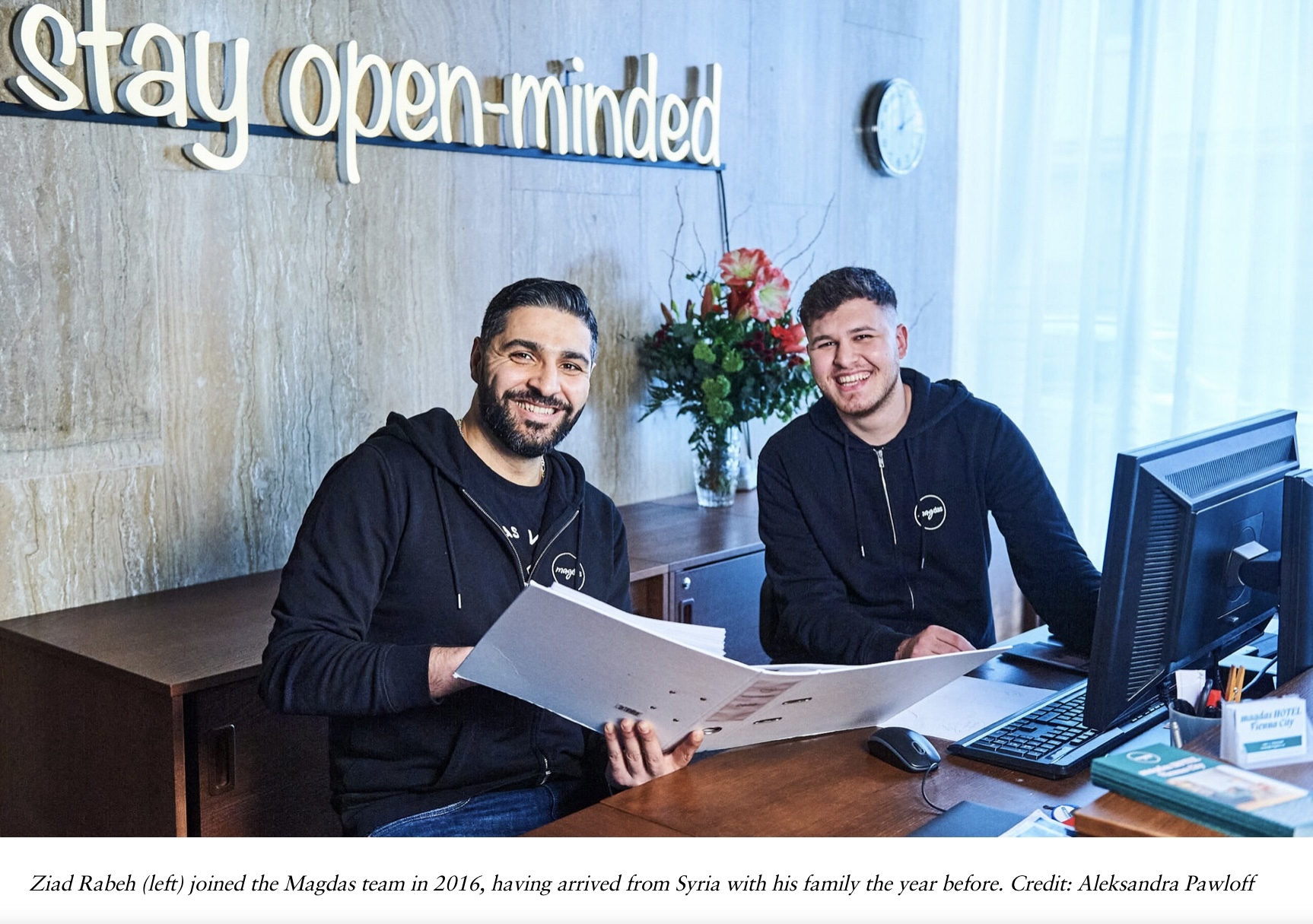
Most guests come to Magdas Hotel in Vienna, Austria, looking for nothing more than the good service, comfortable rooms and central location promised by online reviews. Entering the lobby around midday, the scene is one familiar from countless trendy hotels around Vienna — the cool-yet-cozy décor and quiet music in the background, locals on lunch break slowly filling the restaurant, a gaggle of tourists checking in at the reception desk, taking in their new environment with jet-lagged excitement. A neon sign behind the reception reminds them to “stay open-minded.”“With time (the guests) might notice that many of us working here aren’t Austrian, that many cultures are represented, and they ask what’s going on here,” says Ziad Rabeh, the head receptionist. “And then we tell them our story.”
Magdas Hotel opened on Valentine’s Day 2015, with the purpose of helping refugees integrate into the job market by offering employment and training. Over 1.3 million migrants applied for asylum in Europe over the course of that year, kicking off Europe’s so-called migrant crisis. As countries struggled to accommodate the new arrivals — and, in some cases, erect border fences — charities, NGOs and social businesses across Europe rallied to help them rebuild.
While there is no universal definition of successful integration for refugees, work is generally considered a crucial component — but it’s not easy to come by. Finding employment in a new country without a social network, local language skills or recognized education certificates can feel like an insurmountable task. In Austria, restrictions on access to the job market during the often lengthy asylum application process further complicate matters, so that, on average, it takes refugees almost three years longer than other migrants to enter the Austrian labor market.
“Here the people we employ are no longer guests but hosts, and can make good use of the qualities they bring with them,” says Gabriela Sonnleitner, who has been running Magdas for almost a decade. “And Austria is a tourist destination. There is always a demand for skilled workers in this sector.”
After initial training, Ziad Rebah apprenticed as a hotel manager, eventually taking over as the head of reception in 2021. For Rabeh, Magdas’s commercial success is a point of pride: “People with asylum come from other countries, other cultures, they’re afraid, and the people aren’t very open-minded about them. But Magdas proves that it can work.”
Building a self-sustaining business while serving a marginalized and often vulnerable group comes with many challenges. “We learned a lot in those first years, we were quite naïve,” Sonnleitner says with a laugh. “We had five experienced hotel employees and 20 refugees who have never worked in the service industry before. We quickly realized that this ratio doesn’t work.” Over the years, the hotel invested heavily in training and communication, which was the biggest challenge for such an international team — both in terms of language and culture.
The hotel also employs a social worker who comes by once a week. “Many of the people working here have very difficult life stories and are still processing things,” says Sonnleitner. The social worker also helps them navigate the practical aspects of building a new life in Austria, like moving out of temporary accommodation, sorting out language courses and navigating bureaucracy. “She helps them feel more stable and get their lives in order so they can work well and integrate well into the workplace.”
Even so, accepting the limitations of the project was an early lesson, and a hard pill to swallow. “We learned that we can’t solve all the problems in the world,” says Sonnleitner. “At the beginning it totally overwhelmed us. We can help with work integration, but all the other problems, the trauma they might still be processing, that is beyond our capacities.”
In addition to offering training on the job, Magdas launched three apprenticeship programs — for cooks, restaurant experts and hotel managers — in the autumn of 2017, hosting around 10 apprentices at any given time. About 35 percent of young people in Austria pursue practical vocational training. A foundational part of the Austrian education system, this training combines a paid apprenticeship with part-time studies at a vocational school. “Afterwards you have an official education in Austria and good options going forward,” says Sonnleitner. After a completed apprenticeship many jump straight into the job market, but it’s also possible to continue training or complete the Matura examination to attend university.
Ten years in, Magdas has integrated over 100 refugees into the job market. It currently employs 43 people from all over the world, with around 20 languages spoken on the team. Magdas’s success offers proof that a social business doesn’t have to sacrifice its bottom line. In autumn 2022 the hotel moved from the former retirement home on the edge of Prater Park to a new central location, this one a former priest’s residence that was thoroughly renovated with an eye towards circularity and sustainability. Meanwhile, the original location will be renovated to a high environmental standard and reopened as a second Magdas Hotel in 2027, providing 42 additional training and employment opportunities.
This success and growth gives the social effort at its core an additional aura of legitimacy — there’s no question that it’s a sound business model. “Social entrepreneurs are perceived as more legitimate because they are so close to the market, especially in job market integration,” says Vandor.
This was the case for Rabeh, but while he is by now fluent in German, has passed the Austrian accountant examination and received his Austrian citizenship last year, he is planning to continue working at the reception for the time being. “I believe in Magdas,” he says. “I might go back to accounting later, but for now I find I can support people better at the reception. Magdas gave me this chance, and I want to pay it forward.”