

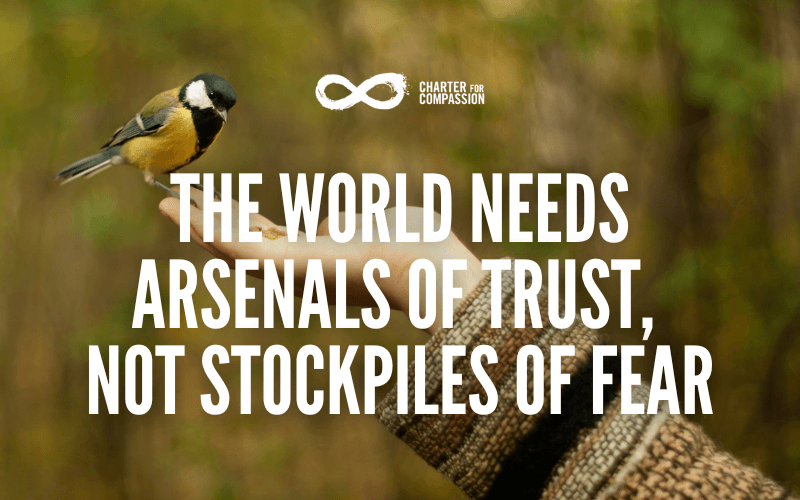
On October 24, the world will mark 80 years since the United Nations Charter came into force with its founding pledge to safeguard peace through collective security. However, humanity still clings to thousands of nuclear weapons that endanger the very peace the UN Charter was meant to protect. To renew this founding promise, we have to replace these instruments of fear and leaders who are addicted to wealth and power with the only true safeguard—trust born through dialogue. This, of course, directly reflects the Charter for Compassion’s “recommitment to empathy, justice, and mutual respect as the foundation for a peaceful world.”
In 1957, Japanese educator Josei Toda, speaking in Mitsuzawa Stadium, Yokohama to 50,000 youth, condemned nuclear arms as the ultimate evil—an assault not just on life itself but on humanity’s right to exist. His disciple, the late third president of the lay Buddhist Soka Gakkai International, Daisaku Ikeda, carried that vow to the world stage, submitting forty annual peace proposals to the United Nations, urging progress through dialogue, education, and global cooperation—not through military force—as the key to peace.
Eight centuries earlier, the Buddhist reformer Nichiren predicted a future age when arrogance and conflict would eclipse compassion and wisdom. That warning feels all too familiar today—with our fractured alliances, proxy wars, and leaders who treat mass destruction as a bargaining chip. And yet, Nichiren maintained that renewal was always possible—if people have the courage to act with a moral conscience.
Lasting harmony doesn’t grow through silence or intimidation. It can’t be built through the military might autocrats like Trump, Putin, Netanyahu and Kim Jong Un are using. Because when dialogue breaks down, suspicion takes root. When dialogue endures, trust begins to grow.
This isn’t idealism—it’s plain common sense. Past instances of international cooperation on public health and arms reduction have proven that progress starts when adversaries find common ground. Dialogue isn’t weakness—it’s a national defense. Without it, mutual respect and the golden rule can’t survive. As we’re seeing in the Ukraine where the rhetorical use of tactical nukes has entered the unimaginable realm of possibility.
For over 80 years, governments have relied on deterrence in the belief that nuclear weapons prevent war. But this demands perfection in a species defined by error. We’ve seen how radar systems misread data and how brinkmanship spirals — how fragile every system is when human judgment falters. And the integration of artificial intelligence into the very fabric of our society adds yet another unknown dangerous factor.
Even when deterrence “works,” it inevitably poisons the societies that depend on it. Fear—not dignity—becomes the organizing principle of security. As Ikeda warned, that’s spiritually unsustainable. A culture built on fear can’t nurture peace.
Dismantling warheads isn’t enough. What we need is to build arsenals of trust—cooperative structures that include treaties, cultural and educational exchanges, and scientific partnerships working on the global crises that threaten us all. The very foundation of nonprofits like the Charter for Compassion.
These aren’t merely soft substitutes for weapons. They’re stronger defenses—because they protect what survival actually depends on: human dignity. Trust can’t be legislated or forced—it’s earned. Dialogue’s the only soil where it can take root. And of course, this has to be grounded in the golden rule — the willingness of polarized sides to truly hear each other’s needs and concerns.
Humanity stands at a dangerous crossroads. The stakes have never been higher. One path clings to deterrence, betting that our luck won’t run out. The other embraces interconnection—the understanding that our lives rise or fall together.
Toda, Ikeda, and Nichiren each believed renewal was possible, even in times of decline. Their shared conviction was simple: life’s dignity must come first. Living up to that vow means refusing to let fear decide our fate.
This change starts with each of us—right where we are. For the sake of future generations, let’s demand that our leaders rise above rivalry and greed. Because trust through dialogue and peace through trust is the only defense worthy of a world that hopes to endure.
A retired industry executive, Michael Lisagor is the author of eight books including Romancing the Buddha and My Fifty Years of Buddhist Practice, and a longtime Washington Technology columnist. Early Charter supporters, Mike and his patient wife of 56 years live on Bainbridge Island, WA. His books can now be read for free at: BooksByMike.org.