

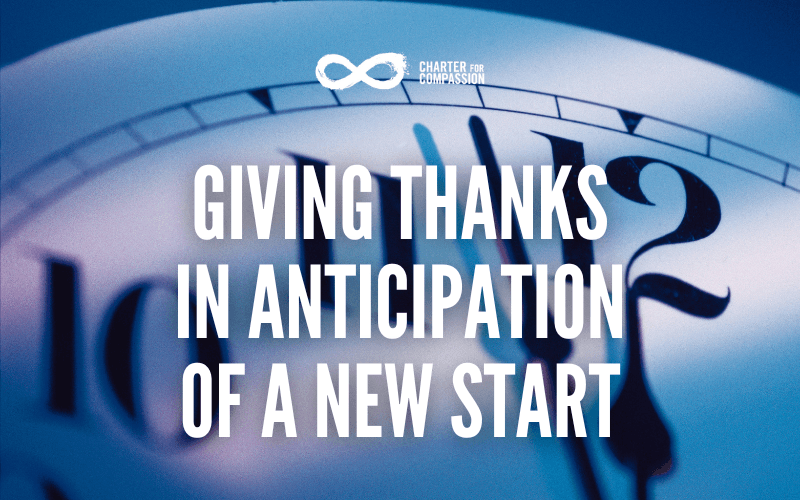
When the Clock Strikes Midnight: What Will We Choose?
Over the past few weeks, in meetings, conversations, and quiet one-on-one exchanges, I’ve heard something that feels different from previous years. People aren’t just looking forward to the new year—they’re yearning for it. There’s an almost palpable longing for the world to reset, as if when the clock strikes midnight on December 31, a door might swing open, and we could simply step into a new beginning… a clean slate, bright and waiting.
Perhaps this longing is intensified by the catastrophic weight we’ve been carrying: the unthinkable suffering in Sudan, Gaza, and Ukraine; the erosion of governmental systems that once gave a sense of stability; the questioning of traditions that once offered continuity and comfort. When the world feels unmoored, we naturally reach for the promise of a fresh start.
But a new year, of course, does not remake the world for us.
It invites us to remake ourselves.
The clock can only carry us forward in time; we must carry forward our commitments, our courage, our compassion.
The poet Mary Oliver once asked, “What is it you plan to do with your one wild and precious life?”
The question isn’t about the date on a calendar—it’s about the agency we hold in our hands every day.

As we prepare to leave 2025 behind us, perhaps our task is twofold:
1. To remember what was good.
Even in a year marked by extraordinary hardships, rays of light have pierced through. Acts of generosity, unexpected friendships, the quiet heroism of people caring for one another, global collaborations for peace, young people rising with new vision—these things matter. They are not footnotes; they are the architecture of hope.
Gratitude is not a denial of suffering.
It is a reminder that the world still contains seeds worth planting.
Reflecting on the good of 2025 is not naïve—it is necessary. It strengthens our capacity to carry hope into 2026.
2. To ask ourselves what we will choose next.
If we long for a different world, we cannot wait for it to arrive. We must help build it—one decision, one conversation, one compassionate action at a time.
The historian Howard Zinn wrote:
“To be hopeful in bad times is not just foolishly romantic.
It is based on the fact that human history is a history not only of cruelty,
but also of compassion, sacrifice, courage, and kindness.”
The new year will not change unless we change.
Unless we choose the hard work of healing, repairing, and renewing.
Unless we recognize our agency—our ability to influence the circle around us, and through it, the wider world.
So how do we reboot—truly reboot?
We begin by asking ourselves:
- What can I let go of from this past year that no longer serves my spirit or my community?
- What commitments do I want to deepen?
- How can I practice compassion more intentionally—with strangers, with loved ones, and perhaps most importantly, with myself?
- What conversations do I need to have?
- What joyful work am I ready to begin?
The answers do not have to be grand. A compassionate world is built on the accumulation of small, steady acts. On the courage to envision something better. On the belief that our actions matter.Because they do.
A Final Blessing for the Crossing
As 2025 draws to a close, my wish for all of us is simple:
May we enter the new year not merely with hope,
but with agency.
Not merely with longing,
but with resolve.
Not merely with grief for what has happened,
but with gratitude for what has sustained us.
Not merely with a dream of a better world,
but with the commitment to help build one.
The clock will strike midnight.
A new year will arrive.
But it is our shared humanity—our compassion, our courage, our willingness to act—that will shape what comes next.
And that is something worth believing in.
With warmest regards,
Marilyn