
Date: Wednesday, February 11 @ 11:00 AM PDT
Check your local times using this date/time converter.
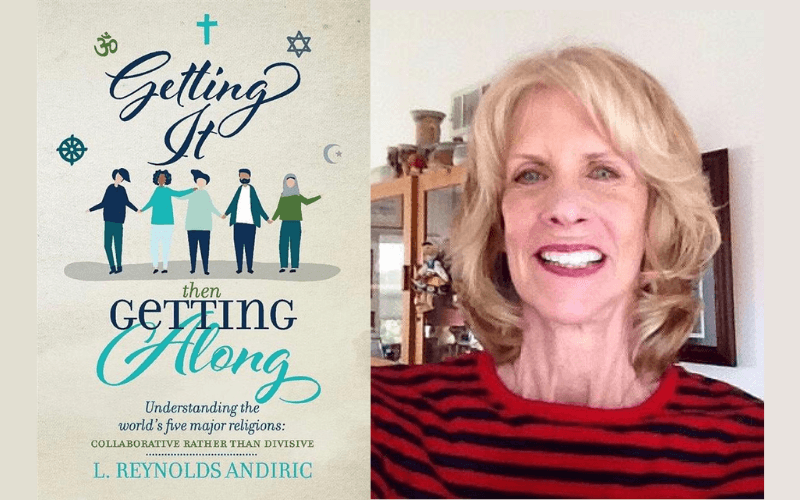
Although this book is about religion, it is not a book of religious dogma. The intent is to explain the foundation, the evolution and how each of the five major systems of faith is practiced today. It examines the Abrahamic religions (Judaism, Christianity and Islam) and the ancient, yet still practiced by many, religions of Hinduism and Buddhism. Even though the book describes the philosophy of each religion, it is written in laymen terms that are understandable and of interest for anyone. Without a doubt, many people do not know that Islam is an Abrahamic religion and most do not realize that there are many commonalities among the five major beliefs (by number of population who practice each)—in fact, there are more commonalities than differences, although there are REAL and significant differences also. For each religion's review, a learned consultant who practices or leads in that faith has assisted with the book’s content.
The author's desire for those who read the book is that they will have a better understanding and therefore a greater tolerance for those who have religious beliefs different than their own. The book encourages that individuals do not gain their knowledge from social media sources, but rather they search in meaningful ways for the truth and foster an attitude of open, respectful discourse with those who have different faiths. The book also takes note that, for the most part, what we believe is primarily a result of our culture and heritage with little real knowledge about other religions.
If the reader can change his or her outlook to be more understanding and therefore more tolerant of others, one by one, the world will become a kinder, gentler place. If this works for religion, it may also work for the other things that divide us such as race, gender, nationality, politics etc. Lastly, there may be a realization that our different perspectives combined, may lead us to solve some of our most difficult problems on the planet. The sum of our beliefs may be truly greater than the individual parts.
About the Author

Linda Reynolds Andiric grew up in northern Ohio, where she graduated from Kent State University with a B.S. in biology and chemistry. She worked at the Cleveland Clinic in the medical laboratory before living abroad in Scotland, Denmark, and Germany. Upon return to the U.S., she married, had a son, and ultimately settled in St. Augustine, Florida, where she adopted a daughter from Vietnam and worked as the administration and technical director of the medical laboratory/pathology services at an acute care hospital. Later, after earning her doctorate in educational leadership, she became affiliated with the American Society for Clinical Pathology and the CDC as part of the PEPFAR project. Her work as a consultant in Global Health entailed writing curricula to teach medical laboratory quality management in Africa, Asia, Haiti, Guyana, Tajikistan, and Ukraine. During this period, she began to write regularly and published a memoir, Living with Heart.
Fascinated with differing spirituality and religious beliefs worldwide and dismayed at the discord and violence resulting from religious misunderstandings, she wrote Getting It, Then Getting Along. The book is a treatise of the world’s five major religions explained in layman’s terms and written with the hope of resolving misunderstandings and fostering collaborative attitudes as opposed to combative, violent reactions prevalent today. The book explains the five religions' origins, evolution, beliefs, and current practices. Getting It, Then Getting Along is the recipient of several book awards: Readers’ Favorite 5-Star Award, Literary Titan Gold Book Award, and a silver award for the Royal Palm Literary Award 2021. It is also listed on Destiny Discover: Follett School Solutions – a website for teachers to search for school textbooks.
About the Facilitator: Nancy E. Murphy, MA

Nancy’s current role is serving as a Compassionate Ambassador-at-Large and the liaison between the Charter for Compassion and Compassionate St. Augustine. Committed to life-long learning, Nancy has been pursuing compassionate studies since 2020, through courses and active engagement with the International Charter for Compassion and Compassionate St. Augustine. She developed a college course on compassion and has been instrumental in the creation and development of the Gift Gardens and Purple Bench initiatives to provide healthy options and foster compassionate conversations. Currently Nancy is co-lead of the Charter’s Justice and Integrity Pillar, and within that Pillar the focus on Peace.
Nancy’s life’s work to date has included a high level of caring and compassion with strong foci on belonging, collaboration, diversity, inclusion, and racial, social, and environmental justice. Through her study and application of Student Services Nancy values and practices the #1 rule of Student Services, which is to create a welcoming environment. She is eager to increase and apply her knowledge, skills, and abilities to model and promote compassion in her communities and in our world.