

Photo by Christian Hume on Unsplash
The articles in this section offer both the science and the lived experience of compassion in the context of extraordinary human suffering. Together, they weave insights from leading thinkers like Professor Paul Gilbert—whose work on Compassion-Focused Therapy has helped reframe compassion as an evolved human capacity and a trainable skill—with urgent, ground-level reporting and research from Gaza.
Gilbert’s writings provide a foundation for understanding compassion as more than an emotion: it is an intentional practice that can help individuals and communities regulate threat, process trauma, and respond with care rather than fear or hostility. These principles resonate deeply in Gaza, where cycles of violence and displacement have left profound psychological scars.
The accompanying articles from journalists, public health experts, and mental health professionals reveal what compassion looks like in action under the harshest conditions. They bring us into the clinics, schools, and temporary shelters where Gazans care for one another, even as they grapple with their own losses. They also offer stark data on the mental health crisis: the prevalence of PTSD, depression, and anxiety; the collapse of infrastructure; and the creative, culturally rooted ways communities seek to heal.
From theoretical models to statistical evidence to human stories, these pieces underscore a shared truth: compassion is not a luxury. It is a survival skill—essential for individual resilience, community cohesion, and the long journey toward justice and peace.
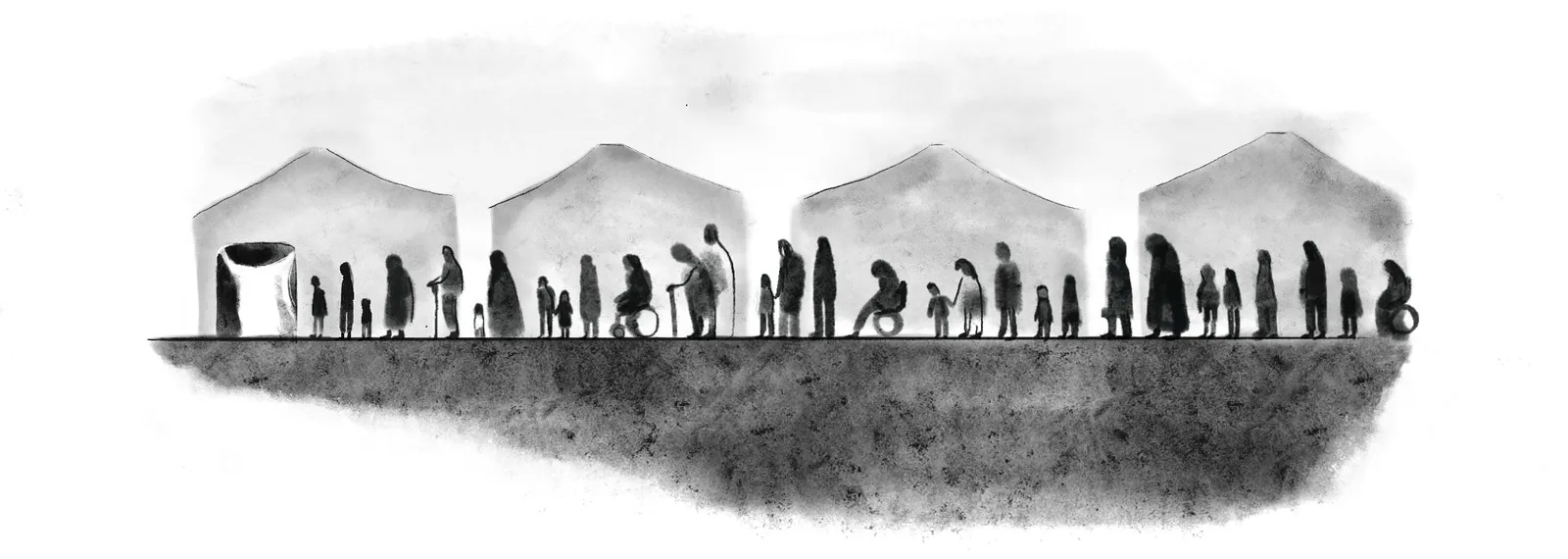
Illustration by Shira Seri Levi
“The Mental-Health Workers of Gaza” – The New Yorker (published August 2025).
This moving profile by Mohammed R. Mhawish documents the extraordinary efforts of Gaza's mental-health professionals, such as Dr. Bahzad al‑Akhras, who continue treating deeply traumatized children under unimaginable strain. Working in makeshift clinics with minimal resources, they offer psychosocial first aid through compassion, CBT tools, and bare essentials, despite their own losses and displacement.
“Treating Gaza’s Collective Trauma” – The New Yorker (published August 2025).
This piece follows mental-health managers like Nour Jarada, witnessing the psychological collapse of Gazan children and communities. It offers harrowing yet compassionate portraits of clinical care in spaces now transformed by trauma, where traditional therapy has collapsed and survival depends on shared humanity through coloring books and whispered reassurance.
“A narrative review of mental health and psychosocial impact of the war in Gaza” – Ibrahim Aqtam (2025, East Mediterranean Health Journal).
This review synthesizes recent findings (2010–2024) on PTSD, anxiety, depression, and complex grief among Gaza’s civilians. It identifies key intervention gaps—especially in culturally adapted, community-based support—and calls for resilience-building through integrated, context-sensitive strategies.
“Prevalence and correlates of anxiety, PTSD, and depression in Gaza” – MR Zughbur et al. (2025, Conflict and Health).
Using data collected between November 2024 and January 2025, this study reveals staggering mental health burdens: 83.5% of respondents met criteria for probable PTSD, 72.7% had moderate to severe depression, and 65% experienced moderate to severe anxiety. These findings underscore the acute need for tailored psychological interventions.
“Mental health rehabilitation in Gaza” – M. Qutishat (2025, Disaster Medicine and Public Health Preparedness).
A systematic review identifying critical barriers to delivering mental health services during ongoing conflict. Highlighted obstacles include infrastructural damage, restricted access, shortages of trained professionals, distrust in institutions, and socio-economic pressures—all of which must be addressed to rebuild effective mental health care systems.
“Gazan women’s mental health during genocide” – B. Hamamra (2025, SpringerOpen Public Health).
Through qualitative interviews with displaced women in Rafah, this phenomenological study captures the compounded psychological burdens faced by women in Gaza—loss of privacy and dignity, food insecurity, structural violence, and gender-based trauma—while also emphasizing resilience, social support, and cultural coping practices.
Annotated Reading List:
Paul Gilbert on Compassion, Conflict, and Systemic Change
Professor Paul Gilbert’s pioneering work on compassion offers both a scientific framework and a practical pathway for fostering care in individuals, communities, and systems. Drawing from evolutionary psychology, neuroscience, and clinical practice, Gilbert explains that the human brain operates through two primary motivational “algorithms”: control-and-hold and care-and-share.
In both humans and other species, these two strategies organize brain systems in very different ways. Control-and-hold focuses on competition, dominance, and protecting one’s own resources or group. Care-and-share fosters cooperation, empathy, and mutual support. Compassion arises most readily in the care-and-share mindset, but can be weakened—or shut down—when control-and-hold dominates. This is particularly visible in political and conflict contexts, where leaders and groups may limit compassion to their immediate allies while dehumanizing or disregarding those outside their in-group.
Gilbert’s insight is that changing beliefs alone is not enough. For compassion to take root, we must also change the contexts in which people operate—contexts that can stimulate and activate the brain’s compassion systems, even in those inclined toward control-and-hold strategies. This involves creating social, political, and cultural conditions that make empathy and cooperation not only possible, but rewarding and sustainable.
In the context of conflict, including the ongoing crisis in Gaza, Gilbert’s work is highly relevant. It helps explain why compassion can feel blocked or absent between opposing sides, and why traditional appeals to moral conscience often fail to reach those driven by control-and-hold motivations. His framework suggests that meaningful peacebuilding requires both cultivating compassion within individuals and altering the conditions that keep hostility, fear, and mistrust in place. For Gaza, this means not only supporting humanitarian relief and trauma recovery, but also addressing the systemic environments—political, social, and security-related—that either constrain or encourage the brain’s capacity to care.
The open-access papers included here explore these ideas in depth. They examine how compassion is rooted in our evolutionary history, how it can be trained and strengthened, and how these principles can be applied to conflict resolution, governance, and community healing. For anyone engaged in peacebuilding or humanitarian action, Gilbert’s work offers a roadmap for expanding compassion where it may be most absent—and most urgently needed.
1. Compassion: From Its Evolution to a Psychotherapy
Source: Frontiers in Psychology (2020) — Open Access
Link: Read Full Article
Summary: This paper offers a comprehensive overview of compassion from an evolutionary perspective, explaining how caring behaviors emerged to support survival and well-being. Gilbert outlines the psychological and physiological systems involved in compassion, and describes how Compassion-Focused Therapy (CFT) can help people regulate fear, anger, and shame.
Relevance: Provides a foundational understanding of how compassion can be cultivated even in high-stress environments—critical for addressing trauma in conflict zones like Gaza.
2. The Origins and Nature of Compassion-Focused Therapy
Source: British Journal of Clinical Psychology (2014) — Open Access version available via ResearchGate
Summary: Explores the evolutionary roots of CFT, showing how our “three-circle” emotion regulation model—threat, drive, and soothing—shapes behavior. Emphasizes how compassion can help rebalance these systems, reducing threat-dominated responses.
Relevance: Explains why conflict situations escalate when threat systems dominate, and how fostering “soothing systems” through compassion can de-escalate tensions between groups.
3. Compassion as a Social Mentality: An Evolutionary Approach
Source: Current Opinion in Psychology (2019) — Open Access
Link: Read Full Article
Summary: Discusses compassion as a “social mentality”—a pattern of thinking, feeling, and behaving that orients people toward alleviating suffering. Details the role of social context in activating or suppressing compassion.
Relevance: Highlights the importance of changing environments to encourage “care-and-share” over “control-and-hold,” directly relevant to rebuilding trust in divided societies like Israel/Palestine.
4. Compassion as a Skill: A Comparison of Contemplative and Evolution-Based Approaches
Source: Mindfulness (2023) — Open Access
Link: Read Full Article
Summary: Compares Buddhist contemplative practices and evolution-based psychological models, showing how both approaches can train compassion as a skill.
Relevance: Bridges spiritual and scientific frameworks—helpful for interfaith and intercultural peacebuilding in Gaza, where both religious and secular traditions inform community life.
5. Exploring Compassion and Its Dark Sides
Source: Frontiers in Psychology (2017) — Open Access
Link: Read Full Article
Summary: Examines how compassion can be inhibited or manipulated—particularly by those in positions of power who operate primarily from control-and-hold motivations.
Relevance: Vital for understanding why appeals to empathy may fail with political leaders or armed actors, and what systemic changes are needed to foster more inclusive compassion.
6. Compassion and Altruism in the Context of Evolution
Source: International Journal of Cognitive Therapy (2017) — Open Access
Link: Read Full Article
Summary: Frames compassion and altruism as evolved strategies for survival and group cohesion, with insights into how these traits can be nurtured through education and culture.
Relevance: Offers strategies for embedding compassion into long-term peace education initiatives in conflict-affected regions.
7. An Introduction to the Evolutionary and Contextual Psychology of Compassion
Source: Clinical Psychology Review (2020) — Open Access
Link: Read Full Article
Summary: Introduces the idea that compassion is context-sensitive, shaped by social, political, and environmental factors. Describes interventions that modify not only individual mindsets but the systems that influence them.
Relevance: Especially pertinent for Gaza, where structural violence and occupation shape the very contexts in which compassion must operate.