
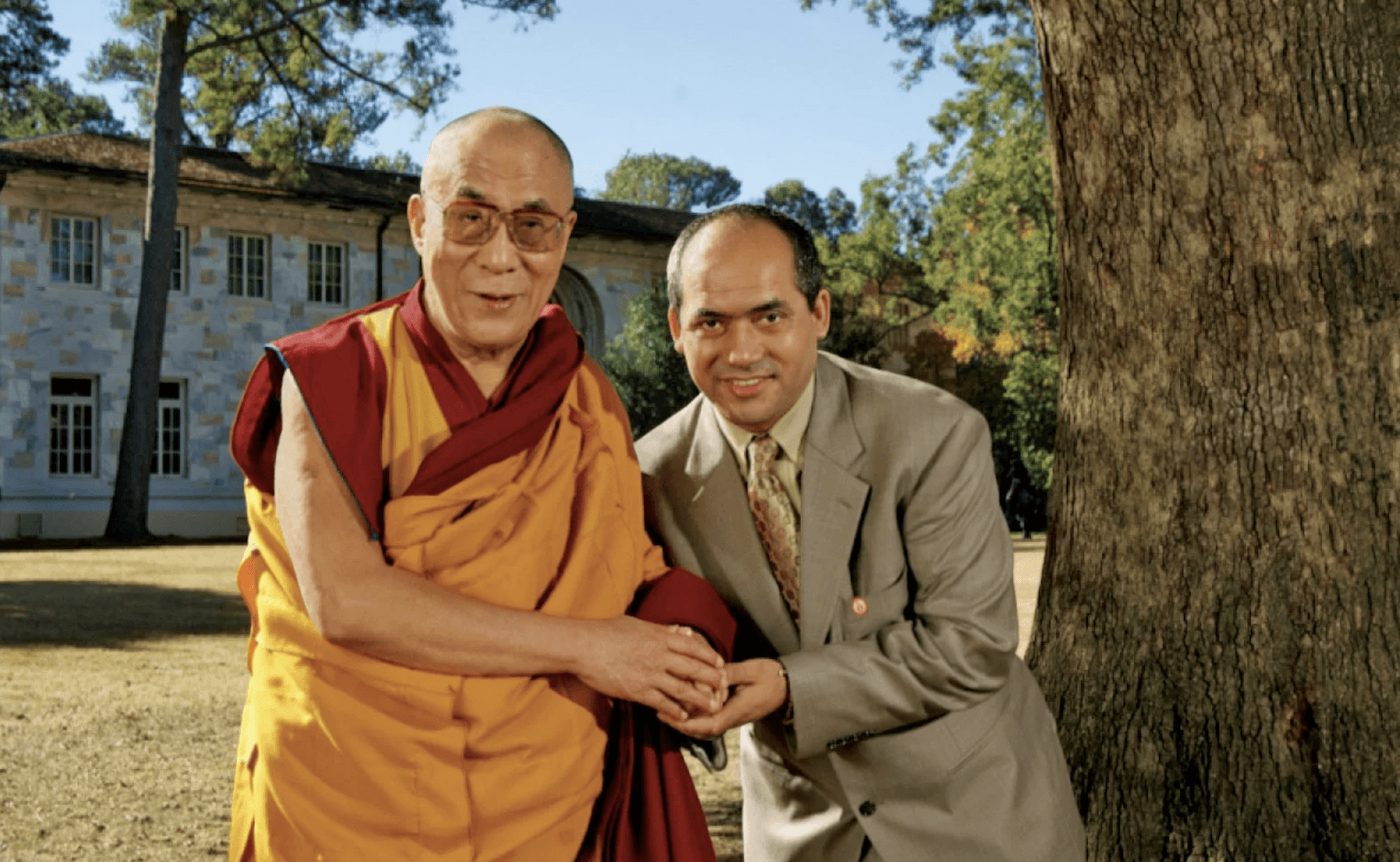
Lobsang Tenzin Negi
Compassion, like a crop, flourishes only when nurtured under the right conditions.
— from the CBCT Manual by Geshe Lobsang Tenzin Negi

Lobsang Tenzin Negi is Co-founder and Executive Director of the Center for Contemplative Science and Compassion-Based Ethics at Emory University (the Emory Compassion Center), formerly the Emory-Tibet Partnership. In this capacity, he has supervised the academic endeavors undertaken by Emory in collaboration with His Holiness the Dalai Lama since 1998. Dr. Negi is also a Teaching Professor in Emory University’s Department of Religion and the founder and spiritual director of Drepung Loseling Monastery, Inc., in Atlanta, Georgia, USA.
Born in Kinnaur, India, Dr. Negi is a former Tibetan Buddhist monk. He received his Geshe Lharam degree in Buddhist Philosophy from Drepung Monastic University and his PhD from the Graduate Institute of Liberal Arts at Emory University. His doctoral dissertation explored the impact of emotions on health from the perspectives of both Tibetan Buddhism and western science. Since that time, he has continued to investigate the relationship between mental/emotional states and physical/social well-being, becoming a pioneer of contemplative science and placing Emory at the leading edge of compassion research.
Dr. Negi developed and now oversees three innovative programs––SEE Learning® (Social, Emotional and Ethical Learning for classroom-based education), CBCT® (Cognitively Based Compassion Training for adult learners), and ETSI (the Emory-Tibet Science Initiative) ––that are at the intersection of science and spirituality.
For his contributions to education, ethics, and the integration of science and contemplative wisdom, Dr. Negi has been awarded several recognitions including Emory University’s prestigious Thomas Jefferson Award in 2024, which honors faculty and staff who have significantly enriched the intellectual and civic life of the Emory community, and a degree honoris causa from Rutgers University in 2025 for his erudition, scholarship, and work at Emory University. In May 2026, Simon and Schuster will release his book, “Engaged Compassion- Seven Practices to Cultivate Resilience, Connection and a Joyous Life.”
***
Can compassion be trained
Primatologist Frans de Waal explains that all human beings share a common foundation of a biologically-based compassion. This biologically-based compassion is limited and only extends to those close to us. As human beings, however, we can extend compassion beyond the few nearest to us, to embrace larger groups. This second level of compassion is a deliberately trainable skill, yet such compassion will only arise if there is a sense of endearment towards others. If that sense of endearment can be cultivated towards larger
sections of humanity, so can compassion.
The actual conditions of our existence are such that we exist interdependently with others. Everything we need for our survival comes from the efforts of countless others, almost all of whom are personally unknown to us. Recognizing this often-neglected fact enables us to feel endearment and gratitude towards others. Such a recognition needs to be deepened through training and practice, otherwise it remains only a superficial thought. When it does become a deep realization, it changes the way we behave and relate towards others.
This model—that a change in our view will change our behavior once it becomes deeply engrained through training and practice—is called lta-spyod-sgom-gsum in Tibetan, which literally means “view, behavior, and meditation.” Spiritual traditions across the world acknowledge that a compassion that embraces others beyond one’s immediate friends and family can indeed be cultivated, but that it does not come easy. Deep thinkers in the sciences, such as Albert Einstein and Charles Darwin, have come to the same conclusion.
Darwin wrote in The Descent of Man, “As man advances in civilization, and small tribes are united into larger communities, the simplest reason will tell each individual that he ought to extend his social instincts and sympathies to all the members of the same nation, though personally unknown to him. This point being, once reached, there is only an artificial barrier to prevent his sympathies extending to the men of all nations and races…
Sympathy beyond the confines of man, that is, humanity to lower animals, seems to be one of the latest moral acquisitions. This virtue, one of the noblest with which man is endowed, seems to arise incidentally from our sympathies becoming more tender and more widely diffused, until they are extended to all sentient beings.”
Similarly, Einstein wrote, “A human being is part of the whole called by us universe, a part limited in time and space. We experience ourselves, our thoughts and feelings, as something separate from the rest. A kind of optical delusion of consciousness. This delusion is a kind of prison for us, restricting us to our personal desires and to affection for a few persons nearest to us. Our task must be to free ourselves from the prison by widening our circle of compassion to embrace all living creatures and the whole of nature in its beauty. The true value of a human being is determined by the measure and the sense in which they have obtained liberation from the self. We shall require a substantially new manner of thinking if humanity is to survive”.
Lastly, His Holiness the Dalai Lama, in his book Ethics for the New Millennium, writes: “My call for a spiritual revolution is thus not a call for a religious revolution. Nor is it a reference to a way of life that is somehow otherworldly, still less to something magical or mysterious.
Rather it is a call for a radical reorientation away from habitual preoccupation with the self. It is a call to turn toward the wider community of beings with whom we are connected, and for conduct which recognizes others’ interests alongside our own”.
Our most current understanding of the brain is that its structure and function can be changed through experience and training. This is called neuroplasticity. If we already have a biological basis for compassion, there is every reason to believe that through training and practice this compassion can be extended, even on a neurological level. In today’s world, we can draw from both the insights of the world’s spiritual traditions as well as the findings of contemporary science to understand compassion and how it can be expanded for our individual and collective benefit. Taking the biologically-given limited capacity for compassion that we already have and expanding it through deliberate training is the focus and purpose of cognitively-based compassion training. It may seem that cultivating unbiased and universal compassion is an impossibility for us, given where we are at the moment. But as human beings we all have the ability to shift our perspectives on things, even if it is slightly at first, and this means that we all have the ability to gradually expand our compassion, even if it happens in baby steps at first.
Watch The Healing Power of Compassion: A Selfcare Tool for YOU! Featuring Lobsang Tenzin Negi, Ph.D.