
When: 12:00 PM EST / 1:00 AM JST (August 8)
View Remembering and Reflecting on History
On this day we invite you into one of the most important responsibilities we share as human beings: the responsibility to remember. We begin and conclude this day, as we do each day of our observance, with the Nuclear Prayer—a prayer that calls us not only to seek God's guidance but also to examine our own choices as stewards of this fragile planet.
Remembering is more than recalling dates and events. It is an act of conscience. Reflection is more than looking backward. It is the process through which history shapes the decisions we make today and the future we choose to create.
Throughout this day we ask difficult questions. How did humanity arrive at the point where it could unleash such destructive power upon itself? What political, scientific, military, and social forces led to the development and use of the first atomic bombs? What fears, assumptions, and beliefs influenced those decisions? By understanding the historical path that led to Hiroshima and Nagasaki, we are better equipped to recognize the choices before us today.
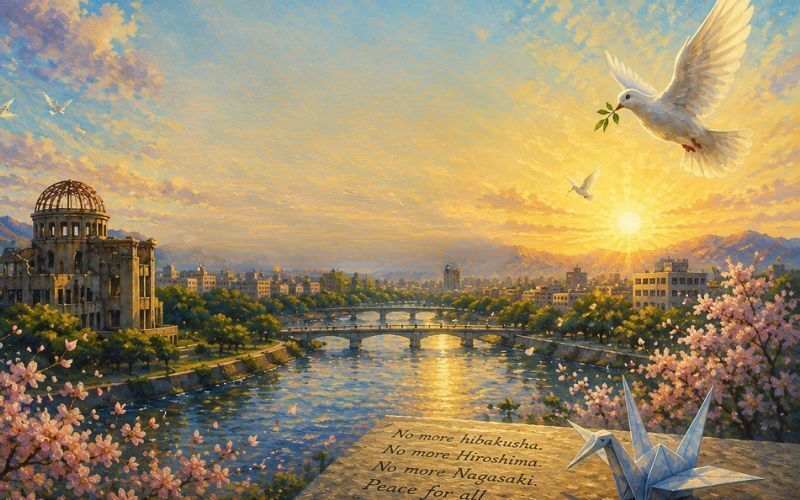
Our remembrance extends beyond the events of August 6 and August 9, 1945. We reflect upon the aftermath of the bombings and the stories that are too often absent from our understanding of history—the "missing pages." We remember the Hibakusha, whose lives were forever transformed by the bombings and whose testimony continues to serve as humanity's conscience. We remember the Korean laborers, prisoners of war, physicians, nurses, relief workers, families searching for loved ones, and children who inherited both trauma and hope. We remember the communities around the world affected by nuclear weapons testing, uranium mining, and decades of living beneath the shadow of the Cold War.
History also invites us to examine the paradoxes that followed the dawn of the Atomic Age. We reflect on the culture that emerged around nuclear technology, the celebration of atomic power, the doctrine of deterrence, the decades of fear generated by the arms race, and the many moments when the world came perilously close to nuclear catastrophe. These are not simply historical episodes; they are enduring lessons about the consequences of fear, power, secrecy, and human fallibility.
Yet this day is not intended to leave us overwhelmed by tragedy. Rather, it seeks to cultivate wisdom. History becomes our teacher, reminding us that while we cannot change the past, we can allow the past to change us. The purpose of remembering is not to assign blame but to deepen understanding, strengthen compassion, and inspire responsibility.
Throughout this broadcast, historical presentations will be interwoven with music, poetry, film, artistic expression, survivor testimony, and moments of quiet reflection. These offerings remind us that history is not merely a collection of facts but a living human story told through voices, memories, art, and lived experience. Together they invite us to see beyond statistics and political narratives to the dignity of every human life affected by nuclear weapons.
As the program concludes, we return once again to the Nuclear Prayer. Having journeyed through the history of the Atomic Age, its words take on renewed meaning. We pray not only for remembrance, but for discernment. We pray not only for peace, but for the courage to build it. We pray that the fog of atomic darkness may finally give way to the light of wisdom, compassion, and shared humanity.
The purpose of remembering yesterday is to protect tomorrow. May the lessons of history awaken our conscience, strengthen our resolve, and inspire each of us to help create a world in which nuclear weapons are never used again.