
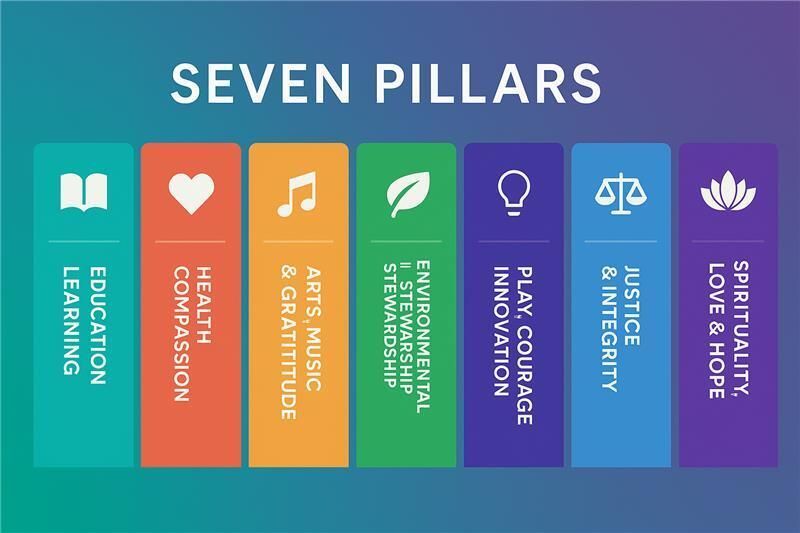
Review the work of each pillar by clicking on the appropriate button below:







From Sectors to Pillars:
A New Chapter for the Charter for Compassion
For the past ten years, the Charter for Compassion has organized its global work through twelve sectors: arts, business, education, environment, gender partnerships, health, peace, restorative justice, science and research, social justice, social services, and spirituality. These sectors provided the foundation for connection, collaboration, and compassionate action across diverse fields. They helped partners find one another, share innovations, and build practical pathways for compassion in schools, neighborhoods, organizations, and communities worldwide.
As the world changes, so too must the ways we organize ourselves. Guided by the philosophy of Ubuntu—I am because you are; you are because I am—the Charter is evolving from twelve sectors into seven interdependent pillars. This transformation reflects our deepening commitment to break down silos, foster collaboration, and create a more holistic, values-driven foundation for compassionate action.
The shift does not erase the work of the sectors. Instead, the sectors live on within the seven pillars, ensuring continuity for long-standing partners while expanding opportunities for collaboration. For example:
- Education + Learning builds upon the education and science & research sectors.
- Health + Compassion encompasses health, social services, and well-being.
- Arts, Music, + Gratitude grows from the arts sector, amplifying creativity as a tool for empathy and unity.
- Environmental Stewardship + Respect continues the work of the environment sector and links with agricultural and sustainability practices.
- Play, Courage, + Innovation carries forward the entrepreneurial spirit of business, youth engagement, and innovative approaches to problem-solving.
- Justice + Integrity integrates restorative justice, social justice, peace and equity-based initiatives.
- Spirituality, Love, + Hope honors the spiritual traditions and interfaith collaborations that have always been at the heart of the Charter.
By transitioning to pillars, we offer partners and communities a stronger, more flexible framework that highlights interconnection rather than isolation. The pillars provide a common ground where grassroots leaders, educators, artists, policymakers, activists, and faith communities can work side by side.
Each pillar is intentionally aligned with the United Nations Sustainable Development Goals (SDGs), linking the Charter’s grassroots action to the global movement for justice, peace, sustainability, and human dignity. This alignment ensures that our work contributes to solving the urgent challenges of our time—poverty, inequality, climate change, health crises, violence, and division—while rooting solutions in compassion, trust, and shared humanity.
This is not simply a structural shift. It is a cultural one. The seven pillars of compassion are an invitation to co-create a world where love, hope, and unity replace fear, division, and self-interest. By joining a pillar, partners continue the legacy of the sectors while building together toward a more compassionate and sustainable future.
| Arts | Arts, Music, + Gratitude | (Peace, Justice, Strong Institutions), SDG 11 (Sustainable Cities & Communities) |
|---|---|---|
| Business | Play, Courage, + Innovation | (Decent Work & Economic Growth), SDG 9 (Industry, Innovation & Infrastructure) |
| Education | Education + Learning | (Quality Education), SDG 10 (Reduced Inequalities) |
| Environment | Environmental Stewardship + Respect | (Climate Action), SDG 15 (Life on Land), SDG 12 (Responsible Consumption & Production) |
| Gender Partnerships | Justice + Integrity | (Gender Equality), SDG 10 (Reduced Inequalities) |
| Health | Health + Compassion | (Good Health & Well-Being) |
| Peace | Justice + Integrity | (Peace, Justice & Strong Institutions) |
| Restorative Justice | Justice + Integrity | (Peace, Justice & Strong Institutions) |
| Science and Research | Education + Learning | (Quality Education), SDG 9 (Industry, Innovation & Infrastructure) |
| Social Justice | Justice + Integrity | (No Poverty), SDG 10 (Reduced Inequalities), SDG 16 (Peace, Justice & Strong Institutions) |
| Social Services | Health + Compassion | (Good Health & Well-Being) |
| Spirituality | Spirituality, Love, + Hope | (Peace, Justice & Strong Institutions) |
Get involved with the Charter for Compassion
by partnering or volunteering in a sector!
Working Within the Pillars
It is important that each pillar team assembles a group of committed members to carry forward its work. These teams should operate in tandem to:
- Define mission and vision: Determine the pillar’s purpose and how its direction confirms and strengthens the mission of the Charter for Compassion.
- Build and renew community: Use the steps of Building a Community on the website to form and reform the team on a regular basis. This may take creativity, but you will find the steps align closely with the collaborative work of each pillar. The Tuckman Model (forming, storming, norming, performing) may be a helpful guide to stay on track.
- Discern priorities: Identify the most pressing issues that fall within the scope of the pillar’s work, recognizing that not all challenges can be addressed simultaneously.
- Align with global goals: When appropriate, consult the United Nations Sustainable Development Goals (SDGs) and review how their targets connect with the pillar’s mission and vision.
- Foster collaboration: Share concerns and opportunities with other pillars and explore ways to work collectively on cross-cutting issues.
- Plan strategically: Establish clear operational goals and design both short- and long-term strategic plans to realize them.
- Mentor and expand membership: Recruit new team members when possible and support them as they come onboard, ensuring a culture of mentorship and shared responsibility.
- Stay connected: Maintain active communication with pillar partners and invite new partners to join the work of the Charter.
- Engage in shared governance: Ensure that at least one team member regularly attends staff and volunteer meetings, and create space in pillar gatherings to update one another on wider Charter activities.
- Review and contribute: Team members may be asked to review reports, proposals, or draft policies. It is the responsibility of each member to provide thoughtful feedback and share observations with the group.
- Represent the pillar: From time to time, members may be invited to join special meetings or retreats. Teams should agree on who will represent their pillar in these gatherings.
- Commit to ongoing learning: Encourage one another to participate in the Charter’s Education Institute. As part of a pillar team, all members are invited to take Education Institute courses free of charge, strengthening both individual capacity and collective impact.