
Participation in the Peace by 2030 Game
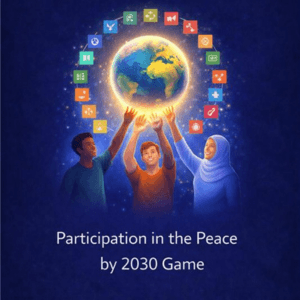
Participation in the World Game offers individuals and communities a unique opportunity to collaborate with people from across cultures, sectors, and regions of the world, all working toward solutions to real-world challenges. While participants will be placed in diverse global teams, the Compassion Transformation Institute strongly recommends that at least three individuals from the same community or organization participate together.
Entering the Game as a small local cohort allows participants to:
- Anchor global learning in local context
- Reflect together between sessions
- Begin translating insights into community-based action
- Invite additional community members to participate in future rounds
Many communities find that starting with three participants creates a strong foundation for expanding engagement in subsequent games.
One of the great strengths of the World Game is that it is not a one-time experience. Participants may return to play again and again—each time bringing deeper insight, new collaborators, and expanded community involvement. Each iteration builds capacity, confidence, and clarity.
The Stages of Playing the World Game
While each game experience is shaped by the people and challenges involved, participants typically move through the following stages:
1. Orientation and Shared Intention
Participants begin by orienting to the purpose of the Game, the collaborative ethos, and the global context. Individuals are invited to reflect on their own motivations, experiences, and hopes, and to bring those perspectives into a shared intention for the work ahead.
2. Formation of Global Teams
Players are grouped into small, diverse teams representing different geographies, cultures, and areas of expertise. This diversity is essential to the Game’s design, encouraging participants to think beyond familiar assumptions and learn from multiple perspectives.
3. Identifying a Shared Challenge or Opportunity
Teams work together to name a real-world challenge or opportunity they want to address—often connected to peacebuilding, social cohesion, sustainability, equity, or community resilience. The focus is on issues that are complex, interconnected, and meaningful to participants.
4. Systems Mapping and Resource Awareness
Participants explore the systems surrounding their chosen challenge—mapping needs, assets, constraints, stakeholders, and interdependencies. This stage helps teams move beyond surface-level thinking and identify where meaningful leverage for change may exist.
5. Generating and Exploring Possible Solutions
Teams engage in creative exploration, generating a wide range of possible responses. Ideas are informed by participants’ lived experience, professional knowledge, and the collective intelligence of the group. The emphasis is on openness, curiosity, and innovation.
6. Weighing, Refining, and Coordinating Action
Using the Game framework, teams assess potential solutions based on feasibility, impact, alignment with shared values, and available resources. Promising ideas are refined into coordinated actions that participants can realistically pursue.
7. Reflection, Learning, and Adaptation
A core feature of the World Game is reflection. Participants examine what they learned about collaboration, systems change, leadership, and themselves. This learning mindset supports adaptation and continuous improvement—both within the Game and beyond it.
8. Bringing Insights Back to the Community
Participants are encouraged to carry insights, tools, and relationships back to their home communities or organizations. Those who participate as a local cohort are especially well positioned to share learning, spark dialogue, and invite others into future rounds of the Game.
A Living, Repeatable Practice
The World Game—developed by David Gershon—is designed as a living practice, not a one-off event. Each time participants return, they bring greater clarity, stronger partnerships, and deeper confidence in their ability to collaborate across differences.
Through repeated participation, communities build:
- Practical skills in systems thinking and collective action
- A shared language for collaboration and compassion
- Momentum that grows from local insight to global connection
Participation in the World Game is both an invitation and a commitment—to learn together, act together, and return again with greater capacity to shape a more compassionate and peaceful world.
If you would like to explore participation for your community or organization, please contact Marilyn to begin the conversation.